

GEO for Service Businesses: How to Get Found in AI Answers
Generative engine optimisation (GEO) is the work of making your business easy for AI tools to understand, trust and mention when someone asks them a question. For a service business, that means being part of the answer when a potential client asks ChatGPT, Gemini or Google’s AI Overviews who can help them.
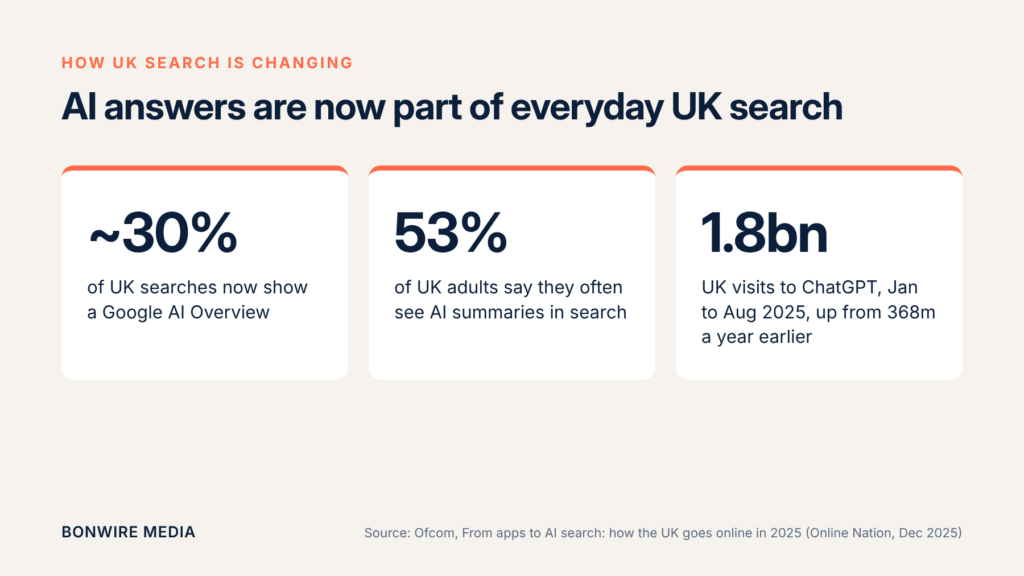
This is already how many people search. Ofcom reports that about 30% of searches in the UK now show an AI Overview, and 53% of adults say they see these summaries often.
ChatGPT had 1.8 billion UK visits in the first eight months of 2025, up from 368 million a year earlier (Ofcom, 2025).
This guide explains what GEO is, how it differs from SEO, what the research says actually works, and what a service business can do about it. It also covers what GEO can’t promise, which often gets left out.
What is GEO, and how is it different from SEO?
GEO is about being chosen and quoted by AI tools, while SEO is about ranking your web pages in search results. They overlap a lot, but they answer different questions:
SEO: can people find your website when they search on Google?
GEO: does an AI tool mention your business when people ask it for help?
The term comes from a 2023 research paper by researchers, including a team from Princeton University, later presented at the KDD 2024 conference (Aggarwal et al.). They described AI search tools as “generative engines” because they write an answer instead of only listing links.
The good news is that GEO doesn’t replace SEO. Google says there are “no additional
requirements to appear in AI Overviews or AI Mode, nor other special optimisations
necessary” beyond its normal search guidance (Google Search Central). A technically sound site with useful content is still the foundation. GEO adds a layer on top: writing and structuring content so an AI tool can extract a clear, accurate answer.
GEO vs SEO at a glance
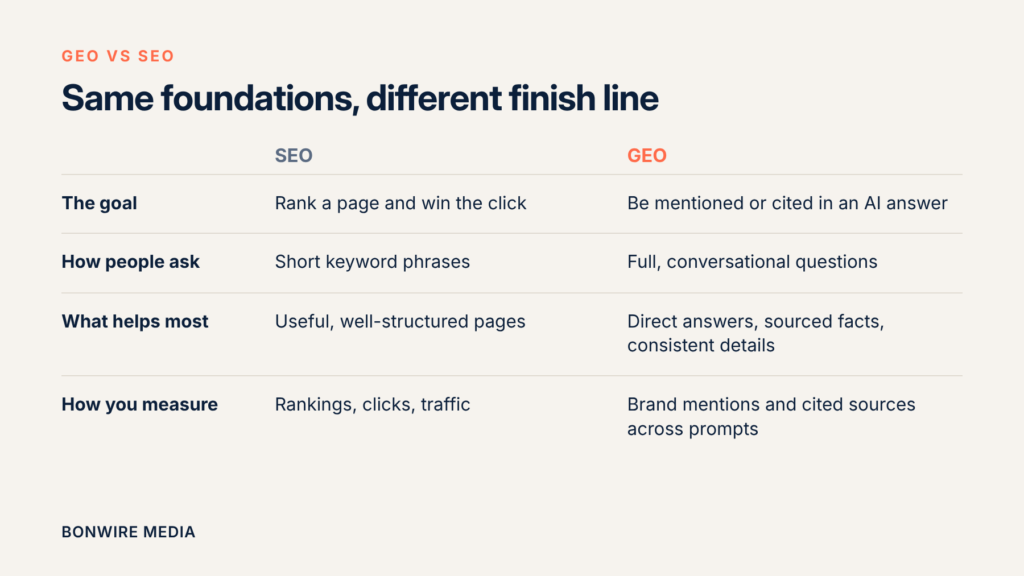
What you’re aiming for. SEO aims for a high ranking and a click. GEO aims for a mention or citation inside an AI-written answer.
How people search. SEO grew up around short keyword phrases. GEO deals with full,
conversational questions, such as “Which agency in Manchester can build my website and set up automation?”
What gets rewarded. Both reward useful, well-structured content. GEO puts extra weight on clear, direct answers, facts with sources, and a business description that’s consistent wherever it appears.
How you measure it. SEO uses rankings, clicks and traffic. GEO tracking is newer and less precise: you check which prompts mention your brand and which sources the AI cites.
Why does GEO matter for service businesses right now?
GEO matters because fewer people are clicking through to websites when an AI answer
appears, and service businesses depend on those clicks for enquiries. Three changes are
driving this.
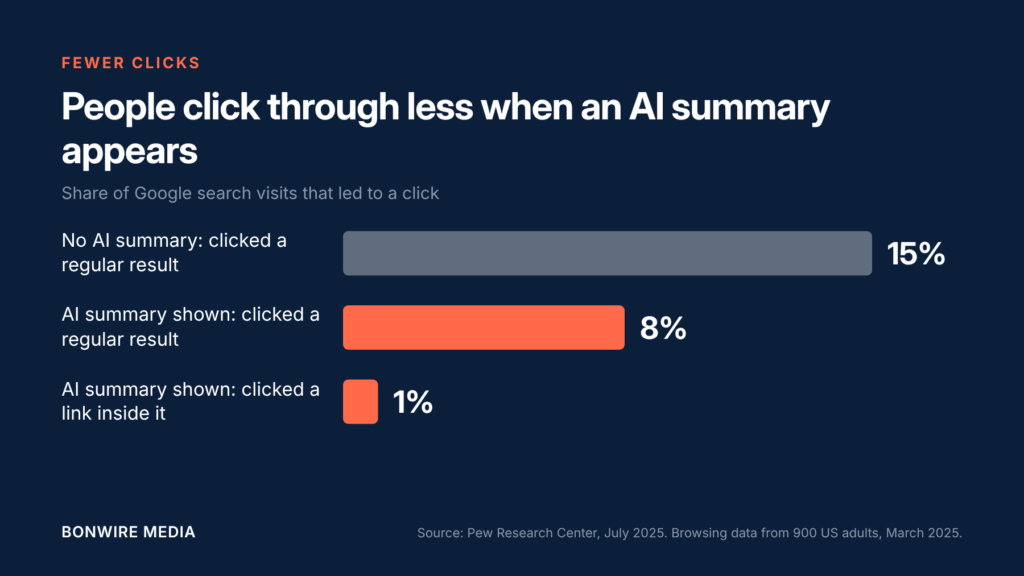
1. People click less when an AI summary is shown. Pew Research Centre tracked the
browsing of 900 US adults in March 2025. When a Google search showed an AI summary, people clicked a regular result in 8% of visits. Without a summary, they clicked in 15% of visits. Links inside the summary itself were clicked in just 1% of visits (Pew Research Centre, 2025). This is US data, but the same AI Overviews run in the UK.
2. Questions are getting longer and more conversational. People type things like “Which agency can build my website and handle AI automation?” rather than “web dev agency automation uk”. Content written only around short keyword strings is out of step with how people now ask, and with how AI tools pull answers together.
3. AI tools summarise rather than list. A search results page gives you ten chances to be seen. An AI answer might name two or three businesses, or none. If your website doesn’t clearly explain what you do, who you do it for and where you work, an AI tool has less to go on when it decides what to say.
None of this means search traffic has disappeared. Google is still used by 82% of UK adults (Ofcom, 2025). It means the way people reach you is changing, and it’s easier to adjust early than to catch up later.
What makes an AI tool more likely to quote your content?
The best evidence so far suggests AI tools favour content that is specific, sourced and easy to quote, and that keyword stuffing doesn’t help. In the original GEO study, the researchers rewrote web pages in different ways and measured how visible each version became in AI-written answers (Aggarwal et al., KDD 2024).
On their main visibility measure, an unchanged page scored 19.3. The strongest rewrites were:
- Adding quotations from relevant, credible people: 27.2
- Adding statistics in place of vague claims: 25.2
- Citing sources for the claims made: 24.6
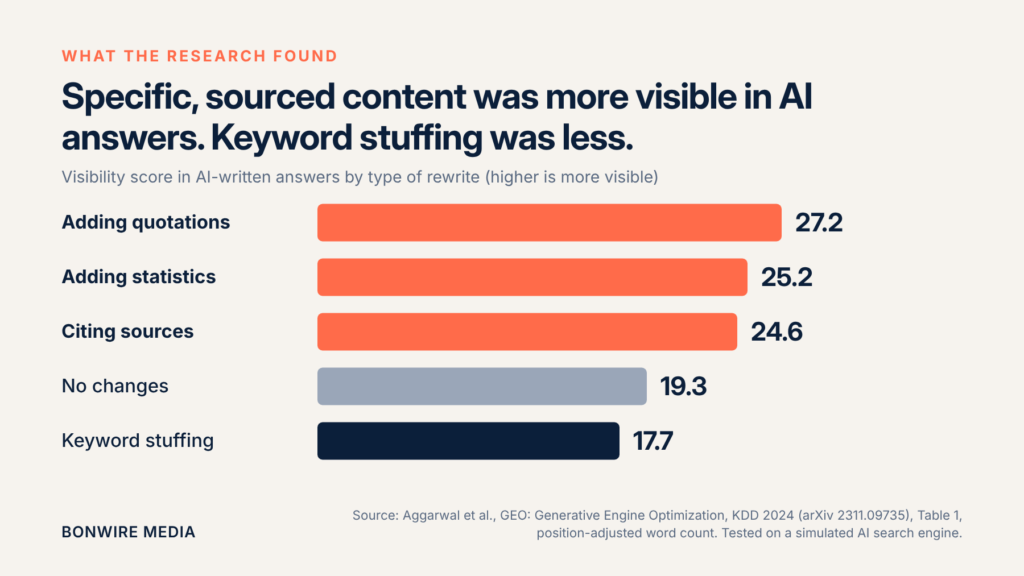
Keyword stuffing, the old SEO habit of repeating search terms, scored 17.7. That’s worse than doing nothing. Overall, the authors report that these methods can boost visibility by up to 40%, and that results vary by subject area.
Two caveats are worth noting. This was a controlled test on a simulated AI search engine, not a live study of ChatGPT or Google. And AI tools change quickly, so treat the findings as a strong pointer rather than a formula. Still, the direction makes sense. Clear facts with sources are easier for any system, or any person, to trust and repeat.
How can a service business get started with GEO?
Start by making your website the clearest, most accurate description of your business
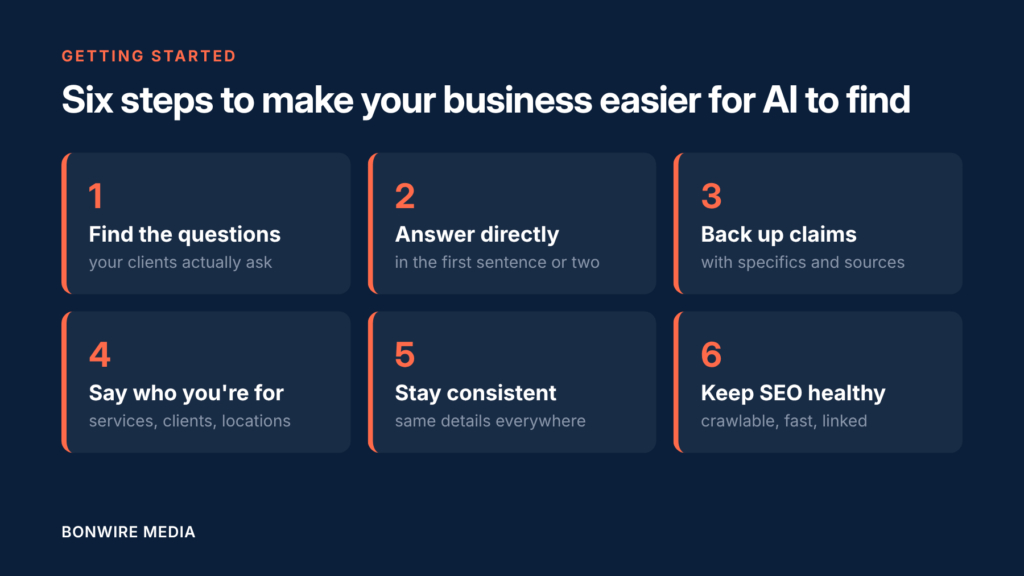
anywhere online, then build out from there. These six steps work for most service businesses, whether you do them yourself or get help.
- Find the questions your clients actually ask. Look at your enquiry emails, sales calls and reviews. Note the exact wording people use, such as “How much does a small business website cost?” or “Can you automate my booking system?”
- Answer each question directly. Put a plain one- or two-sentence answer at the top of the relevant page or section, then add detail. Use headings phrased as questions so both people and AI tools can find the answer quickly.
- Back up claims with specifics. Replace “we deliver great results” with something checkable: a named project, a timeframe, a figure with its source. The GEO research suggests this is one of the most effective changes you can make.
- Explain who you’re for, and who you’re not for. Spell out your services, your typical clients, your locations and your process. This gives an AI tool the details it needs to match you to the right question.
- Keep your details consistent everywhere. Your business name, services and location should read the same on your website, Google Business Profile, directories and social profiles. It’s sensible housekeeping that helps people and machines recognise you as one business.
- Keep the SEO basics in good shape. Make sure search engines can crawl your site, pages load quickly, internal links connect related pages, and important information is written as text, not locked inside images. Google’s own guidance for AI features says exactly this.
Then check your progress. Ask the AI tools your clients use the questions you want to be
found for, note whether you’re mentioned and which sources they cite, and repeat every
month or two. Dedicated AI visibility tools can track this at scale, but a simple spreadsheet is a fine place to start.
What GEO can't promise
No one can guarantee that ChatGPT or Google will mention your business. AI answers vary from person to person and change as the tools are updated. Anyone offering guaranteed AI rankings is overselling. What you can do is make your business the easiest to understand and trust, which also makes your website better for readers.
How does Bonwire Media handle GEO for you?
Bonwire Media is a UK GEO agency that handles the whole job for you: the research, the
writing, the website changes and the ongoing checks. Most service business owners don’t have time to learn a new discipline every couple of years, and they shouldn’t need to. Here’s what that looks like in practice:
- Research. We find the questions your ideal clients ask, in their words, using keyword data and AI search tracking.
- Content. We rewrite your key pages in an answer-first style and create new pages where there are gaps, such as service explainers, comparison pages, guides and FAQ sections. Every claim is checked.
- Structure. We organise your site with question-led headings, clear service pages, sensible internal links and structured data that matches what’s on the page.
- Consistency. We align how your business is described across your site, Google Business Profile and relevant directories, and help you collect genuine reviews.
- SEO foundations. We keep the technical side healthy, including site speed, crawlability and on-page basics, because GEO builds on top of SEO.
- Tracking. We monitor which AI prompts mention you and which sources get cited, then refine over time.
Want to know where you stand?
Book a free GEO visibility audit. We'll check how AI tools describe your business today, show you which questions you're missing, and tell you honestly what to fix first.
Learn MoreFrequently Asked Questions
GEO stands for generative engine optimisation. It means shaping your content and online
presence so AI tools such as ChatGPT, Gemini and Google's AI Overviews understand your
business and mention it in their answers. In other contexts GEO can mean geographic
targeting, which is a different thing.
No. GEO builds on SEO rather than replacing it. Google says there are no special requirements to appear in its AI features beyond normal SEO best practice, so a well-built, useful website remains the foundation for both.
There's no fixed timeline. Changes to your own website can be picked up as soon as pages are recrawled, but building a consistent presence across the web takes months. It's best treated as ongoing work, checked every month or two.
No, and you should be wary of anyone who does. AI answers vary between users and change as the tools are updated. GEO improves your chances by making your business clearer and easier to trust, but it can't control what an AI tool says.
If your clients research suppliers online, it's worth the basics. Answer-first pages, clear service descriptions and consistent business details help with Google and AI tools at the same time, so the effort isn't wasted either way.
Ask the tools directly. Type the questions your clients would ask into ChatGPT, Gemini, Perplexity and Google, and note whether you're mentioned and which websites are cited.
Repeat regularly, because answers change. Our AI Search Readiness Guide
walks you through a fuller self-check.
The bottom line
GEO is how service businesses stay visible as more people ask AI tools for recommendations instead of scrolling through search results. It doesn’t replace SEO. It builds on it, with clearer answers, specific facts with sources, and a business description that’s consistent everywhere.
Nobody can guarantee an AI mention, but a business that’s easy to understand and trust gives itself the best chance.
If you’d like help with any of this, book a free GEO visibility audit with Bonwire Media.
Sources
Aggarwal, P. et al., GEO: Generative Engine Optimisation, arXiv 2311.09735, KDD 2024
Pew Research Centre, Google users are less likely to click on links when an AI summary appears in the results, July 2025; Ofcom, From apps to AI search: how the UK goes online in 2025, December 2025; Google Search Central, AI features and your website