

Why AI Automation Makes Sense for UK Small Businesses and Solopreneurs
AI automation matters for small businesses and solopreneurs because it takes the repetitive admin that eats a small team’s week and hands it to software that works around the clock. Big firms can hire someone to answer enquiries, chase invoices and update spreadsheets. When there are only one or five of you, every hour spent on that work is an hour not spent on clients.
UK businesses have started to notice. The Office for National Statistics reports that AI use among businesses with 10 or more employees rose from around 12% in late 2023 to around 35% by mid-2026, and that 28% of businesses with fewer than 10 employees now use at least one AI technology (ONS, July 2026).
This guide explains what AI automation actually is, why it pays off more for small teams than large ones, which jobs to automate first, and where it isn’t worth your money. It’s written for UK owners who want an honest picture, not a sales pitch
What is AI automation for a small business?
AI automation is software that handles a task from start to finish, using AI to deal with the parts that need judgment, such as reading an email, sorting a document or drafting a reply. It helps separate it from the automation many businesses already use:
• Basic automation follows fixed rules. When a form is submitted, it adds the details to a spreadsheet and sends a confirmation email. It’s reliable, but it breaks the moment something doesn’t fit the rule.
• AI automation can handle messier input. It can read a free-text enquiry, work out whether it’s a sales lead, a complaint or a supplier question, pull out the key details, and send it to the right place with a suggested reply.
Most useful set-ups combine the two. Rules handle the predictable steps, and AI handles the bits that used to need a person to read and decide. A tool like ChatGPT on its own is an assistant you prompt. An automation runs in the background, connected to the systems you already use, whether you’re at your desk or not.
If you want to see what this looks like in practice, our AI Automation Services for small businesses page covers the kinds of workflows we build
Why does AI automation matter more for small teams and solopreneurs?
AI automation matters more for small teams because each hour saved represents a bigger share of the business’s total capacity. Saving five hours a week barely registers in a 500-person company. For a sole trader, it’s most of a working day back.
There are three reasons the case is stronger for small businesses.
1. You don’t have spare people to absorb admin. In a small business, the owner is often also the receptionist, the bookkeeper and the account manager. Automation doesn’t replace a department you never had. It stops you doing that work in the evenings.
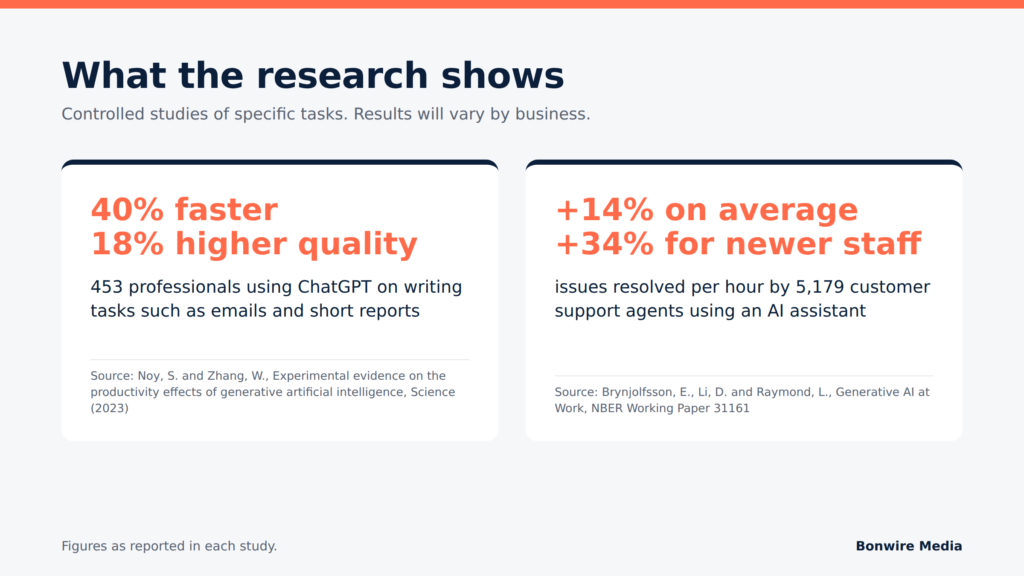
2. The research points to real time savings on everyday tasks. In a randomised experiment published in Science, 453 professionals given access to ChatGPT completed writing tasks such as emails and short reports 40% faster, and their work was rated 18% higher in quality (Noy and Zhang, 2023; MIT News summary). A separate study of 5,179 customer support agents found an AI assistant raised the number of issues resolved per hour by 14% on average, and by 34% for less experienced staff (Brynjolfsson, Li and Raymond, NBER). These were controlled studies of specific tasks, so treat them as a sign of what’s possible rather than a promise for every business.
3. It helps you look bigger than you are. An automation can reply to an enquiry at 11 pm, book a call into your calendar and send the right follow-up. Customers experience a responsive business, even if it’s a one-person business.
How many UK small businesses are using AI already?
Estimates vary depending on who is asked and how. The ONS figure of 28% for businesses with fewer than 10 employees comes from its large official survey (ONS). The British Chambers of Commerce found that 54% of the firms it surveyed in 2026 were using AI, up from 35% in 2025, with 94% of respondents being SMEs (BCC, March 2026).
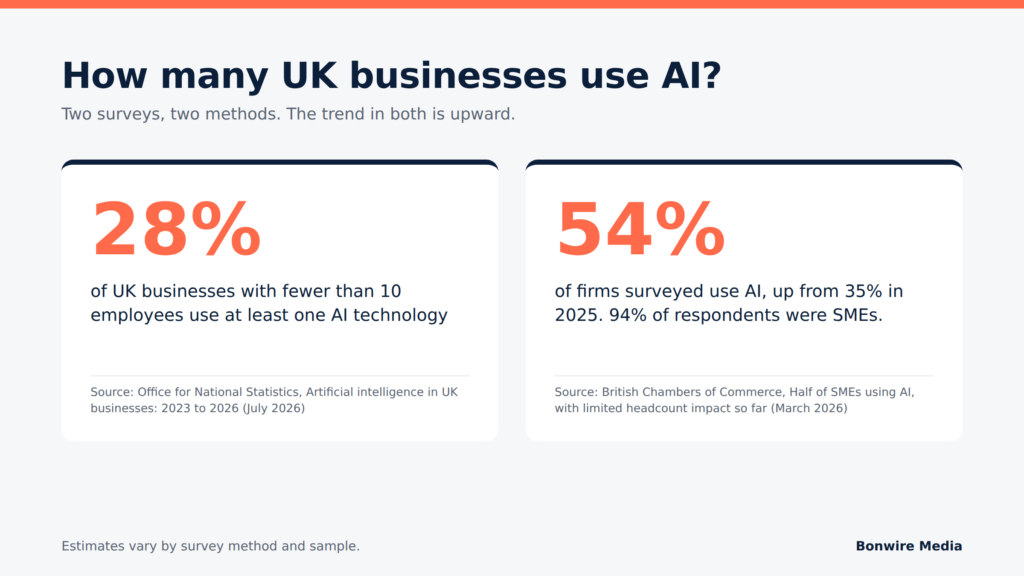
The exact number matters less than the direction. Adoption has grown each year in both datasets. The ONS also notes that use so far is fairly shallow, with the average adopting business using fewer than two AI technologies. That means most small firms are still early, and there’s room to get ahead by doing a few things properly.
It’s also worth knowing what AI hasn’t done so far. The BCC found that 95% of SMEs said AI had no impact on their workforce size over the past year. For most small businesses, it’s adding capacity, not replacing people.
Which tasks should a small business automate first?
Start with tasks that are frequent, repetitive and low risk if something goes slightly wrong. If you do a task every day, follow roughly the same steps each time, and a mistake would be easy to spot and fix, it’s a good candidate.
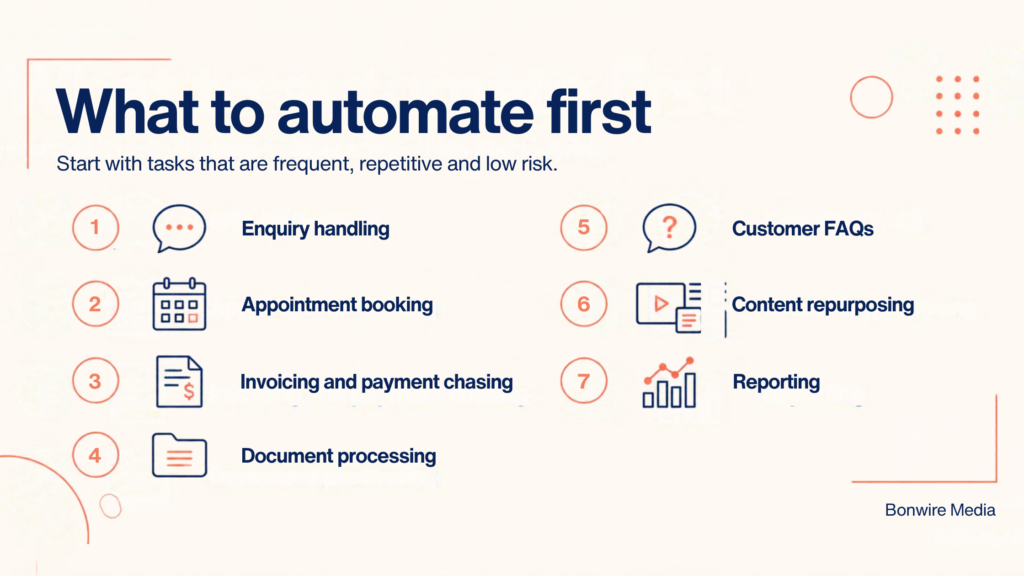
These are the areas that tend to suit small businesses best as a starting point:
1. Enquiry handling
The automation reads website and email enquiries, sorts them by type, logs them in your CRM and drafts a reply for you to approve. It’s a good first project because fast replies win work, and you keep the final say.
2. Appointment booking
The automation offers available slots, books them into your calendar and sends reminders. This cuts back-and-forth emails and missed appointments.
3. Invoicing and payment chasing
The automation creates invoices from completed jobs and sends polite reminders when payment is late. It’s rule-based, easy to check, and directly affects cash flow.
4. Document processing
The automation pulls key details from receipts, supplier invoices or forms into your accounting software. This removes manual copying, which is where typing errors creep in.
5. Customer FAQs
The automation answers common questions on your website using your own information, and hands anything unusual to you. It frees up time without risking complex conversations.
6. Content repurposing
The automation turns a blog post into draft social posts, an email newsletter and a summary. You still edit, but you’re not starting from a blank page.
7. Reporting
The automation pulls figures from your tools into a weekly summary. It replaces a job most owners put off.
A useful rule of thumb: automate the process you complain about most. If you can describe it in a few steps and it happens every week, it’s worth a closer look.
For a deeper look at the website side of this, including forms and chat that feed straight into your automations, see our custom website development for small businesses page.
When is AI automation not worth it?
AI automation isn’t worth it when the process is rare, when mistakes are costly, or when the real problem is something else. Being clear about this saves money and keeps you from automating a mess.
When the task happens rarely. If you do something twice a year, the time spent setting up and maintaining an automation will likely outweigh the time it saves.
When accuracy really matters, and nobody checks. AI can be confidently wrong. A Harvard Business School and Boston Consulting Group experiment with 758 consultants found that AI helped them finish tasks within its capabilities 25.1% faster and at higher quality. But on a task outside those capabilities, consultants using AI were 19 percentage points less likely to reach the correct answer than those without it (Dell’Acqua et al., 2023). Anything involving legal advice, tax decisions, medical information, or large payments needs a person to check the output.
When the process itself is broken. Automating a confusing process just makes the confusion faster. Sort out the steps on paper first. Sometimes that alone fixes the problem, and you don’t need AI at all.
When a simpler tool would do. Plenty of jobs are handled well by the built-in features of software
you already pay for, such as scheduled emails in your email platform or recurring invoices in your
accounting tool. Use those first. AI should earn its place.
What about data protection and UK GDPR?
If your automation handles customer or staff personal data, UK GDPR still applies. That means knowing where the data goes, which AI provider processes it, whether it’s used to train their models, and whether you have a lawful basis for using it. The Information Commissioner’s Office publishes guidance on AI and data protection that covers accountability, transparency, accuracy, and fairness. The ICO notes that this guidance is under review following the Data (Use and Access) Act, so check the latest
version before you rely on it.
In practice, for most small businesses, this means choosing business-grade tools with clear data terms, keeping sensitive data out of free consumer AI apps, and updating your privacy notice to mention how you use AI.
How do you get started with AI automation?
The best way to start is small: pick one process, automate it properly, measure the result, then move on to the next. Here’s a simple plan any small business can follow.
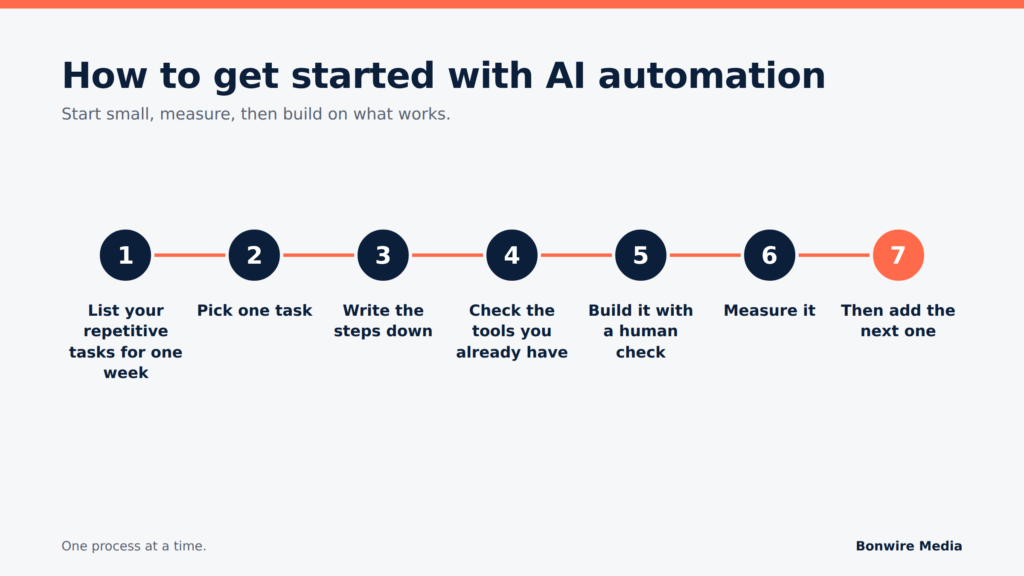
1. List your repetitive tasks for one week. Note anything you do more than twice. Rough estimates of time spent are fine.
2. Pick one task. Choose something frequent, rule-based and low risk. Enquiry handling or invoice reminders are good first choices.
3. Write the steps down. If you can’t explain the process in a few steps, tidy it up before automating anything.
4. Check the tools you already have. Your CRM, accounting or email software may already do part of the job.
5. Build it with a human check. Let the automation draft, sort or prepare, and have a person approve anything customer-facing until you trust it.
6. Measure it. Compare time spent, response times or errors before and after. If it isn’t helping after a month, change it or switch it off.
7 Then weave in the next one. The real value comes when your automations connect, so an enquiry becomes a booking, then an invoice, then a follow-up, without anyone retyping details.
One automation alone is useful. The bigger gains come when your website, your tools and your automations work together, so information flows through the business without anyone copying it from one place to another.
Not sure where to start?
Book a free consultation with Bonwire Media, and we'll look at your current processes together and tell you honestly which ones are worth automating and which aren't.
Click HereFrequently Asked Questions
Yes, for the right tasks. It's worth it for work that's frequent, repetitive and easy to check, such as enquiries, bookings and invoice reminders. It's rarely worth it for tasks you do only occasionally or where mistakes would be costly without a human review.
Yes. Many no-code tools let you connect apps and add AI steps without writing code. The harder part is usually deciding what to automate and mapping out the steps clearly, which is where an outside view can help.
For most UK small businesses, not so far. The British Chambers of Commerce found 95% of SMEs said AI had no impact on their workforce size over the past year. It's mostly being used to give existing people more time.
It depends on the task and how many systems it connects. A single, well-defined workflow is a far smaller job than connecting your whole business. Starting with one process keeps the time and cost manageable and shows you whether it's working before you go further.
It can be, if you choose tools with clear business data terms and follow UK GDPR. Avoid pasting personal data into free consumer AI apps, check whether a provider uses your data for training, and read the ICO's guidance on AI and data protection.
Indirectly. Automation can help you publish useful content more consistently and respond to customers faster, which supports your reputation. But being found and recommended by tools like ChatGPT and Google's AI Overviews depends on your website, content and wider online presence. Our AI Search Readiness Guide walks through how to check where you stand.
Not at all! We specialize in custom integrations with your existing software to ensure a smooth, hassle-free transition. There are no technical headaches.*
On average, clients see time savings of 20–30% and cost reductions within the first few months. We’ll help you identify the best automations for near-term business impact.
The bottom line
AI automation makes sense for small businesses and solopreneurs because it gives small teams back the hours admin takes. Evidence shows real gains on everyday tasks, UK adoption is rising year on year, and most firms use it to support people rather than replace them. It works best when you start with one clear, repetitive process, keep a person checking anything important, and build from there.
If you’d like a second pair of eyes on where automation fits in your business, book a free consultation with Bonwire Media
Sources
• Office for National Statistics, Artificial intelligence in UK businesses: 2023 to 2026, July 2026 • British Chambers of Commerce, Half of SMEs using AI, with limited headcount impact so far, March 2026 • Noy, S. and Zhang, W., Experimental evidence on the productivity effects of generative artificial intelligence, Science, 2023 • Brynjolfsson, E., Li, D. and Raymond, L., Generative AI at Work, NBER Working Paper 31161, later published in the Quarterly Journal of Economics • Dell’Acqua, F. et al., Navigating the Jagged Technological Frontier, Harvard Business School working paper, 2023 • Information Commissioner’s Office, Guidance on AI and data protection